
Between Papers and Power
Repatriation is supposed to mean “return.” But what happens when the place you come back to doesn’t feel like home, and the place you left still lives in your body?

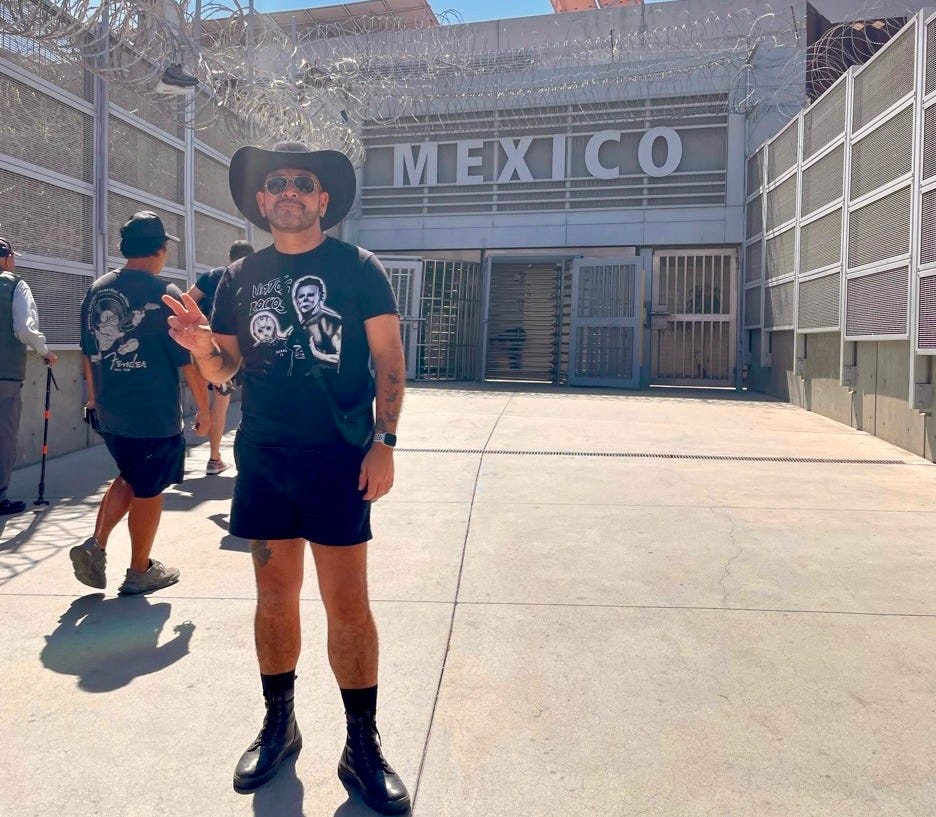
Repatriated, Not Free
After more than forty years living in the United States, I’ve repatriated.
I’ve come back to a country I knew mostly through memory, phone calls, and family stories, a place that always felt like both a wound and a possibility.
I am no longer undocumented. I have papers, in another country, but I have them. I cross borders freely now.
And yet, I still don’t feel free.
People often say things like, “You must feel so relieved now,” or “It must be such a weight off your shoulders.”
And yes , there is relief in no longer living under the daily threat of detention, deportation, or separation. But what remains is the quiet residue of fear, the kind that doesn’t leave when you leave a country.
Because the truth is, the trauma of American authoritarianism, the one that hides beneath the myth of democracy, does not dissolve with a visa stamp or a plane ticket home. It stays with you. It takes root in your body.
The Body Remembers
I still freeze when I see police lights.
Even in a different country, even when I know they aren’t looking for me, I tense up. My chest tightens. My breath shallows. I go silent.
It’s an instinct, the kind you develop after decades of living undocumented in a country that tells you daily that your very existence is a violation. I learned to be cautious with every word, to watch my tone, never to draw unnecessary attention. Survival demanded it.
I became fluent in invisibility.
And yet, I also learned to make myself visible, strategically, publicly, defiantly, to fight for the rights of others like me. I spent much of my adult life organizing, speaking, and building movements for racial justice, immigrant justice, and dignity.
That contradiction, being both unseen and seen, hiding while shouting, shaped who I am. And even now, years later, I still catch myself asking for permission to exist. I hesitate before speaking up, or question whether I deserve to take up space in public.
Freedom doesn’t come naturally when you’ve spent a lifetime being told you don’t belong.
Repatriation Is Not Return
Repatriation sounds clean, like a neat closing of a circle.
But the truth is messier. You don’t return as the same person who left. The place you called home doesn’t wait unchanged.
I am getting to know this country again, like an estranged relative who looks familiar but feels distant. I move through it with curiosity and tenderness, but also with the lingering reflexes of a man who once had to look over his shoulder at every stoplight.
Sometimes I feel like I’m living in translation, between languages, between histories, between the man America made me and the man I am still becoming here.
I’ve learned that repatriation is not just a physical act. It’s emotional. Spiritual. Political. It’s about trying to reclaim parts of yourself that were confiscated at the border, dignity, voice, belonging, and realizing that some of them may never come back in the same form.
The Bipartisan Border
What’s most painful is knowing that the cruelty I survived wasn’t accidental, it was bipartisan.
In the United States, it doesn’t matter whether the president has an elephant or a donkey next to their name. For undocumented people, the machinery of fear stays the same.
Democrats and Republicans both treat us as pawns in a larger game of power and control.
Every election year, immigration becomes the issue, but never through the lens of humanity. The debates are always about border control, deportations, and surveillance. About who can appear “tougher” on migration. About how many cages are acceptable if the cages have blue or red paint on them.
Rarely do we hear about the contributions we make, the taxes we pay, the families we build, or the culture we sustain. Rarely do they talk about our dignity, our creativity, our love for the only country most of us have ever known.
This is the unspoken truth: America depends on the undocumented, but refuses to see us as human. It is easier to weaponize our existence than to honor our humanity.
The Borders Within
Even outside the United States, I carry its borders inside me.
Not the physical walls, but the internalized ones, the ones that make you flinch at authority, question your worth, or measure your humanity through paperwork.
That is the lasting violence of empire. It colonizes not only land, but the imagination.
And that is why, when I watch what’s happening in Palestine, when I see people living under siege, confined by walls, stripped of movement and dignity, I feel something deeper than sympathy. I feel recognition.
Undocumented people know the language of displacement. We know what it means to be surveilled, to have our existence politicized, to live in a state that thrives on our precarity. That’s why so many of us are connected to the struggle for a Free Palestine, not just as allies, but as people who have tasted fragments of the same system of control.
Our liberation is not separate.
It never has been.
Learning to Feel Free
Here, I am trying to practice freedom in real time.
To move through the world without waiting for permission. To believe that I belong, not because a document says so, but because I exist, and that is enough.
It’s not easy. There are days when I catch my reflection and still see the undocumented man who learned to minimize himself at times. But there are also days when I breathe easier, when I remember that the fight for justice, the one that shaped my entire life, continues wherever I am.
I may have repatriated, but the work remains transnational. The struggle against authoritarianism, against borders both visible and invisible, is shared.
Maybe freedom isn’t a destination after all. It is a daily practice, a quiet rebellion against fear, an act of remembering that we deserve to exist fully, without apology.
Repatriated, yes.
But still learning what it means to be free.
If this reflection resonates with you, if you’ve ever lived between worlds, between papers, between who you were told to be and who you are, you’re not alone. Our stories are bridges, and I write this one in the hope that someone else will cross it too.